
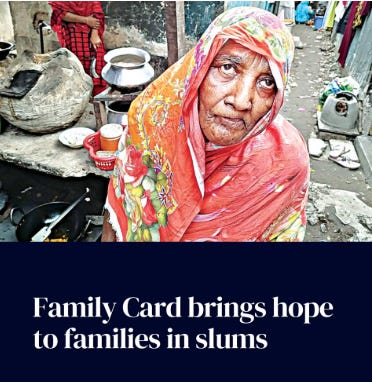
Bangladesh is betting on the Family Card to turbocharge its war on poverty. The Family card is a digital welfare platform that consolidates cash transfers and subsidies into a single, household-based system. The program builds directly on the country’s early success in reducing extreme poverty—from more than 50 percent in the early 1990s to under 20 percent today—largely through pioneering microcredit models led by Grameen Bank and BRAC that empowered rural women and ignited grassroots entrepreneurship.
The Family Card pilot was launched on March 10 by Prime Minister Tarique Rahman.
Some 40,000 families across 14 upazilas now receive 2,500 taka ($21) monthly, paid straight to the female household head via mobile wallets or bank accounts, plus access to subsidized rice, oil and lentils at government outlets.
The contactless smart card links to national ID numbers, merging dozens of overlapping safety-net schemes into one clean database and cutting out the patronage and leakage that plagued earlier programs.
Full rollout to 20 million families by 2030 is projected to drive the national poverty rate from 18.7 percent to 11.3 percent at a cost of 134,000 crore taka ($11.3 billion) over four years—roughly 2 percent of GDP. Success will hinge on flawless digital execution in a nation where efficient targeting has long been elusive.