
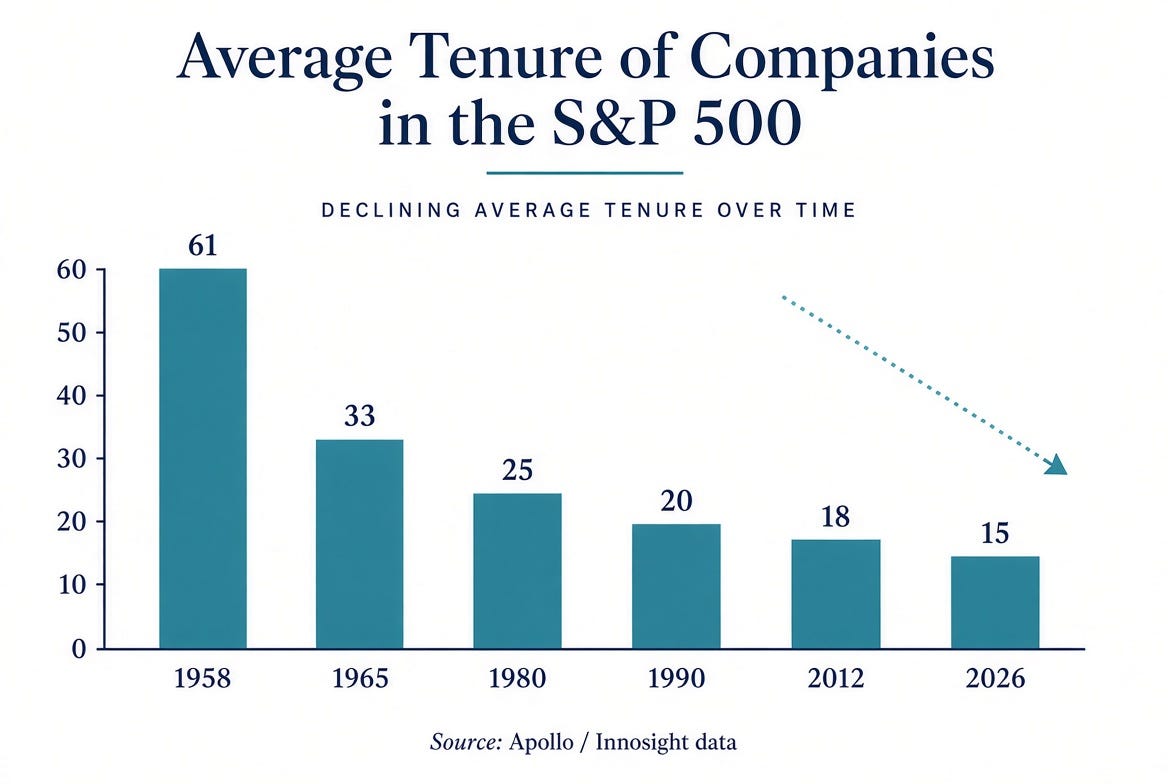
In 1958, a company could expect to remain in the S&P 500 for 61 years. By the start of 2026, that average tenure had fallen to 15 years—down from 25 years in 1980 and 18 years in 2012, according to Apollo economist Torsten Sløk.
Innosight’s long-running analysis of index churn has tracked the same compression: roughly 33 years in 1965, 20 years by 1990, and a forecast of the mid-teens this decade. At current rates, roughly half the companies in today’s index are projected to be replaced by the early 2030s.
These exits are rarely the dramatic bankruptcies that dominate popular memory. Analysis of deletions from 2007 through late 2026 shows that:
42 percent resulted from mergers and acquisitions (including private-equity take-privates),
36 percent from scheduled rebalancing after a company’s market capitalization fell below large-cap thresholds, and
12 percent from spin-offs or splits.
Outright bankruptcies and receiverships accounted for a vanishingly small share.
The underlying drivers are familiar yet intensifying. Creative destruction now operates on a shorter clock. Digital platforms, cloud infrastructure, mobile, and now artificial intelligence allow new business models to scale and displace incumbents before the latter can reconfigure. At the same time, higher volumes of M&A and buyouts remove firms from public markets while they are still large and often profitable.
Here is a key point:
Companies that remain large and public for longer cycles tend to treat re-invention as a core operating discipline
allocating capital to adjacent and transformational bets (before the core erodes),
stress-testing business models against technological and competitive scenarios, and
maintaining boards that actively challenge the assumption that today’s advantages will compound without interruption.
Longevity is no longer a passive inheritance of scale; it is the product of deliberate, repeated adaptation.