
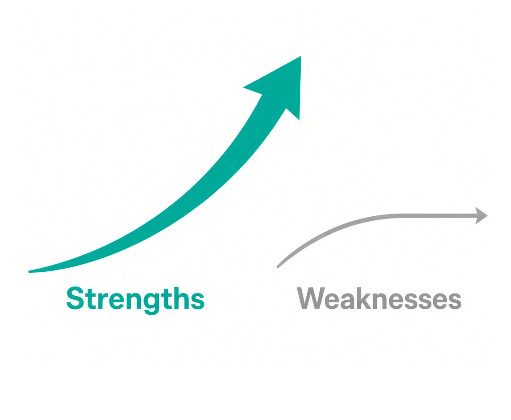
Personal development is often framed as a balancing act between polishing strengths and repairing weaknesses. Evidence from workplace studies, psychology, and competitive dynamics shows the larger returns come exclusively from the former.
Gallup’s analysis of strengths-based programs across 1.2 million employees in nearly 50 thousand business units found consistent gains: 10–19% higher sales, 14–29% higher profit, and sharper engagement. Workers who use their strengths daily are six times more likely to be engaged; managers who emphasize strengths drive 61% engagement versus 9% when the focus is weaknesses. The same pattern appears in positive psychology and leadership research from Zenger Folkman: three or more strengths lift leaders into the top tier of effectiveness, while the absence of weaknesses does not.
The math is asymmetric. Effort spent on weakness-repairs can raise performance from poor to adequate at best.
The same effort applied to a strength compounds toward excellence because existing neural networks grow new connections more readily. Comparative advantage in economics and evolutionary specialization produce the same outcome: returns concentrate where relative efficiency already exists. Hyper-generalists lose ground to those who double down.
Fatal flaws must still be neutralized; they can drop overall effectiveness. Most people do not have them. Once blocking weaknesses are managed (through workarounds, partners, or minimal competence), further investment belongs with strengths.
The practical middle path is real: contain the derailers, then amplify what you already do well. Forced to choose a primary focus, the data favour strengths.
Weakness repair has a low ceiling; strength-building does not.