
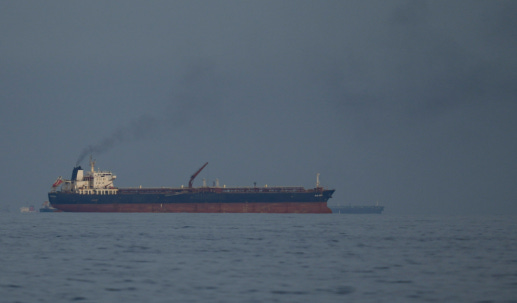
For most of the past decade, the Strait of Hormuz — the narrow 21-mile-wide waterway between Iran and Oman — was famous mainly for carrying about one-fifth of the world’s oil. But it was also the invisible artery for something far more specialized: roughly one-third of global helium.
Before the current conflict, Qatar produced about 63 million cubic meters of helium in 2025, according to the U.S. Geological Survey, out of a worldwide total of roughly 190 million cubic meters. That made the Persian Gulf emirate the planet’s second-largest supplier after the United States and by far the dominant exporter outside North America. Virtually all of Qatar’s helium is extracted as a by-product of natural-gas processing at the massive Ras Laffan Industrial City, the world’s largest liquefied-natural-gas facility. The gas is then chilled into liquid form and loaded onto specialized tankers that have no choice but to sail straight through the Strait of Hormuz to reach customers in Asia, Europe and beyond.
The flow was steady and largely unnoticed. On an average day, the equivalent of about 173,000 cubic meters of gaseous helium — or up to 17 metric tons of liquid helium — left Ras Laffan. Semiconductors had quietly become the single biggest user, accounting for more than 20 percent of global demand and powering the AI-chip boom. MRI scanners, which rely on liquid helium to keep their superconducting magnets at near-absolute-zero temperatures, came in a close second. Aerospace companies used it for rocket fuel tanks and satellite testing; research labs needed it for everything from particle accelerators to quantum computers.
That picture changed abruptly in March 2026. Strikes damaged Ras Laffan’s LNG and helium plants, forcing Qatar Energy to halt production. At the same time, the strait was closed to commercial shipping. The result: essentially zero helium now moves through Hormuz. Repairs to the Qatari facilities could take three to five years. Even if the waterway reopened tomorrow, the stranded cryogenic containers and damaged infrastructure mean the shortfall is not measured in weeks but in months.
Analysts warn that prices could double or triple if the disruption drags on. Chipmakers in South Korea and Taiwan, which imported more than 60 percent of their helium from Qatar, are drawing down stockpiles that will last only a few months. Hospitals are scrambling to conserve MRI coolant. Aerospace programs face delays on cryogenics work.
The Strait of Hormuz has always been an oil and fertilizer chokepoint. What the current crisis has shown is that it is now a helium chokepoint too — one that the modern economy, from the factory floor to the operating room, cannot easily substitute.