
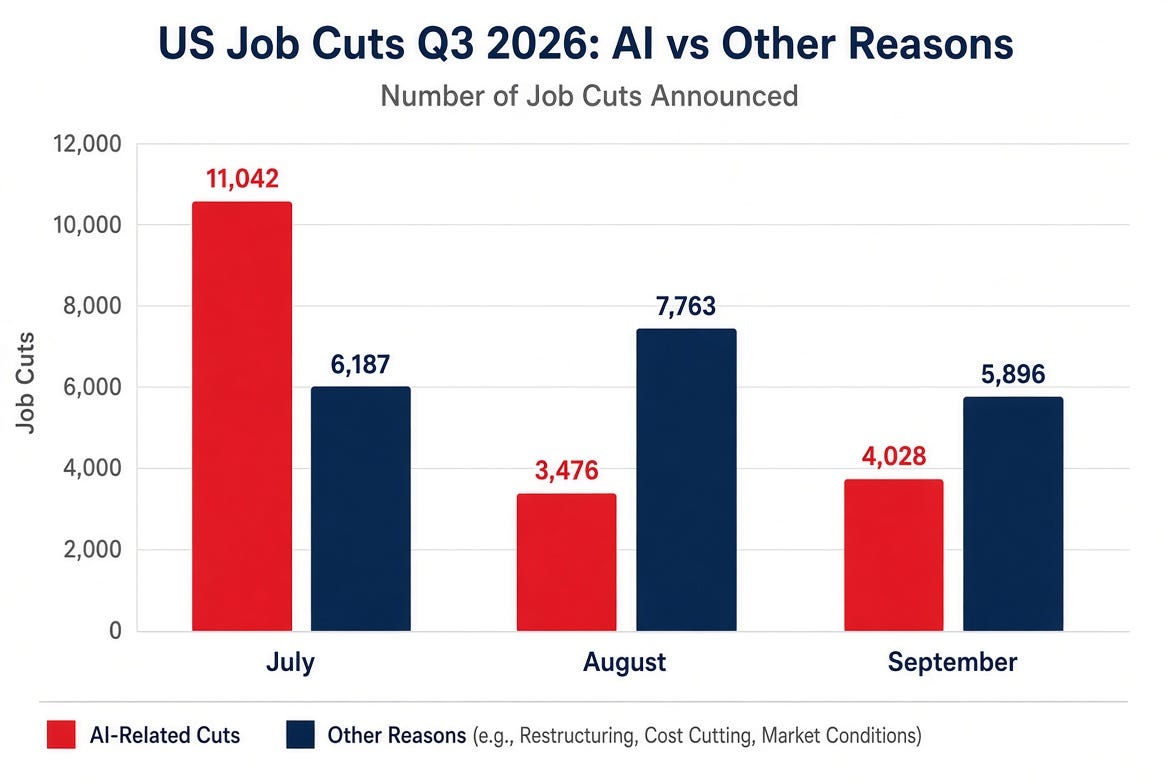
Data from Challenger, Gray & Christmas - a global outplacement firm - on US announced cuts puts AI as the leading reason in July (~10,970 cuts, 33% of the month), then falling to fourth in August (3,462) and fifth in September (3,961, ~9%). Year-to-date through September, AI was cited in roughly 120,000 cuts (~21% of total announced cuts), remaining the top cumulative reason even as monthly dominance faded.
A stricter tracker from AIImpacted.org (only counting cases where the employer explicitly said AI was doing the work) shows far lower Q3 numbers: about 4,300 in July (led by Visa’s 2,600 tech/product roles and Allianz), just 375 in August, and none major in September. Earlier 2026 peaks (e.g., Oracle’s ~21,000) dwarfed the quarter.
Large global cuts in Q3 were dominated by non-AI primary reasons. Volkswagen’s ~50,000, Omnicom’s merger-related ~15,000, Uber’s management flattening (~3,300), Microsoft’s Xbox/commercial reductions (~4,800), and others targeted desk-based, admin, development, and support roles as part of restructurings trigger by cost pressures, EV/tariff issues, and efficiency drives. Companies frequently mentioned AI as an accelerant or investment priority (freeing capital for AI spending) but rarely as sole pure replacement; Microsoft explicitly noted roles were not being replaced by AI.
What does this mean, so far ?
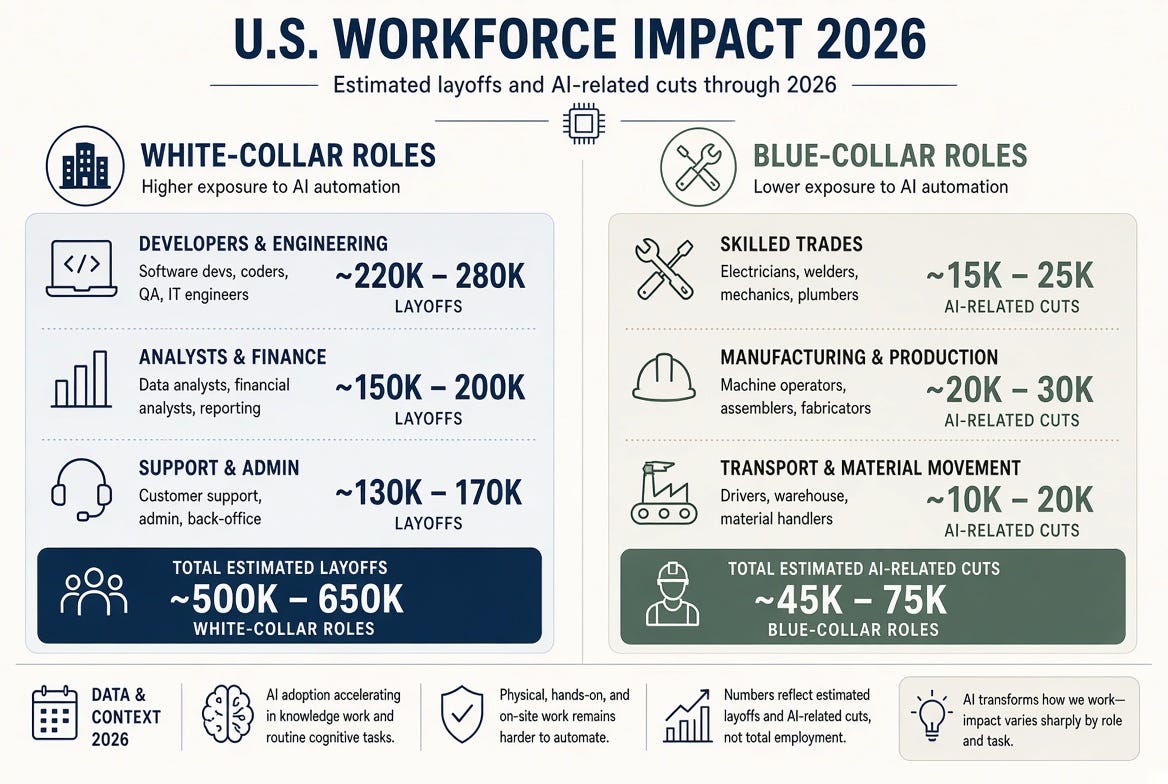
Direct AI job replacement remains limited and concentrated in white-collar knowledge/software/support functions in tech and finance. Blue-collar production roles have been largely spared in the AI-cited data; auto and manufacturing cuts reflect structural industry pressures more than automation of factory floors. Broader “AI-linked” tallies often capture reallocation, post-pandemic trimming, or euphemistic framing (“restructuring,” “efficiency”) rather than robots simply taking the seat. Labour data has not yet shown economy-wide dismantling.
For the future of work, Q3 points to productivity gains and skill shifts (AI oversight, hybrid roles) over wholesale elimination, with white-collar entry/mid-level tasks most exposed near-term while physical and specialized trades hold relative resilience. Hiring continues alongside cuts, and total announced layoffs remain below prior-year peaks in many datasets.
But this is a very rapidly evolving situation. Overall, job displacement by AI-linked new workflows is almost inevitable. The patterns, while giving a sense of less than expected impact to date, should give an idea of the likely direction of the impacts, when they do come, and help inform anticipatory upskilling/reskilling investments by organisations and individuals alike.