
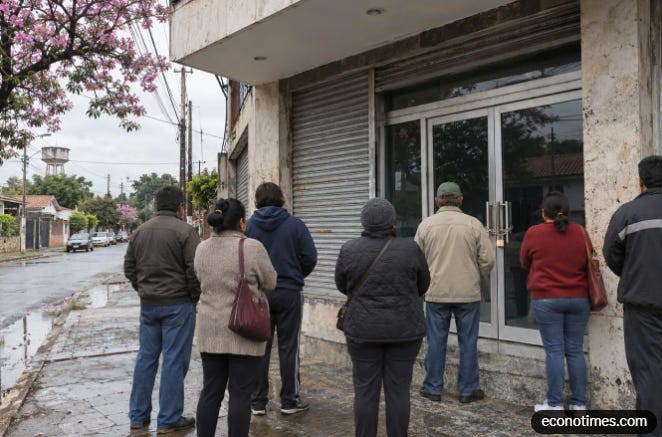
In the early hours of 3 November 2026, Paraguay’s central bank placed Ueno Bank into resolution. Customers woke to a blank app, frozen cards, dead ATMs and shuttered branches. Roughly 2.9 million accounts—about 60% of the adult population—were instantly unreachable. Salaries, pensions, supermarket payments and small-business cash simply disappeared from view.
Ueno had grown from a 2021 fintech into one of the country’s largest banks through aggressive cashbacks, sports sponsorships and the 2024 acquisition of Visión Banco. It also held $800–850 million in public funds, including roughly $380 million from the state pension fund. Its solvency ratio collapsed to 5.56%, less than half the 12% regulatory minimum, after accounting adjustments exposed the true capital position.
The root cause of the collapse was classic and completely avoidable: related-party lending far beyond the legal 20% of effective equity limit. Between September 2025 and May 2026 the bank extended about $146 million to companies linked to its controlling Grupo Vázquez—often on signature alone, without real collateral or proper documentation. Supervisors had flagged the excesses months earlier.
Political connections compounded the failure: President Santiago Peña had been a business partner of the group until 2025, and the central-bank governor had previously led a Ueno predecessor.
The resulting popular protests led to the resignation of the country’s President, who is also being investigated by prosecutors.
For developing countries and other developing markets racing to scale digital financial inclusion, the lessons are:
Customer growth alone is not proof of soundness.
Related-party limits must be enforced in real time by truly independent supervisors.
Public funds and payment rails must be diversified so that no single institution becomes a single point of failure.
Deposit insurance softens the loss but often does not prevent the freeze.
Digital systems that promise instant access also deliver instant exclusion when governance fails.
Hindsight is not really revealing massive lessons in this case: the warnings existed. The political proximity was known. The concentration risk was obvious. The lending practice was of the toxic type.
May this be the last failure of its kind, for the sake of human progress.