
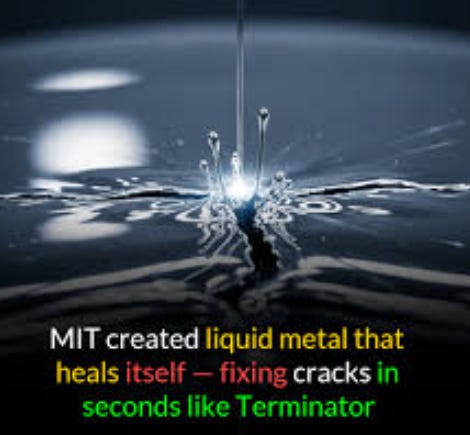
Back in 2023, there was a materials science breakthrough that could redefine the field. Scientists in 2023 observed, for the first time, metals autonomously repairing microscopic cracks, potentially paving the way for more durable infrastructure and machinery.
Researchers at Sandia National Laboratories and Texas A&M University discovered the phenomenon while testing nanoscale platinum under repeated stress. A fatigue-induced crack fused back together via “cold welding” in a vacuum environment, confirming a decade-old theoretical model.
This intrinsic self-healing reverses the conventional view that metal cracks only worsen, though it is so far limited to nanocrystalline structures and specific conditions. Progress has extended to liquid metals like gallium-based alloys, which use fluidity and a self-forming oxide layer to fill damage and restore conductivity.
Recent advances include low-toxicity formulations for recyclable, room-temperature applications, enhancing performance in flexible electronics and batteries through rapid repair mechanisms.
Commercially, the broader self-healing materials market—including polymers and composites—is surging, projected to grow by $6.29 billion from 2023 to 2028 at a 29.52% CAGR, driven by demand in automotive, aerospace, and construction.
While metal-specific products lag, early adopters like BASF and Covestro are integrating self-healing tech in coatings and parts, with shape memory alloys hinting at metallic potential.
The technology’s benefits are compelling: extended lifespans for engines, bridges, and aircraft could slash maintenance costs and downtime, averting economic losses in the hundreds of billions annually in the US alone.
In electronics, gallium alloys promise resilient wearables and energy storage, improving safety and reliability by autonomously mending breaks.
Commercialization remains in nascent stages, but as research scales, self-healing metals may transform industries reliant on structural integrity.