
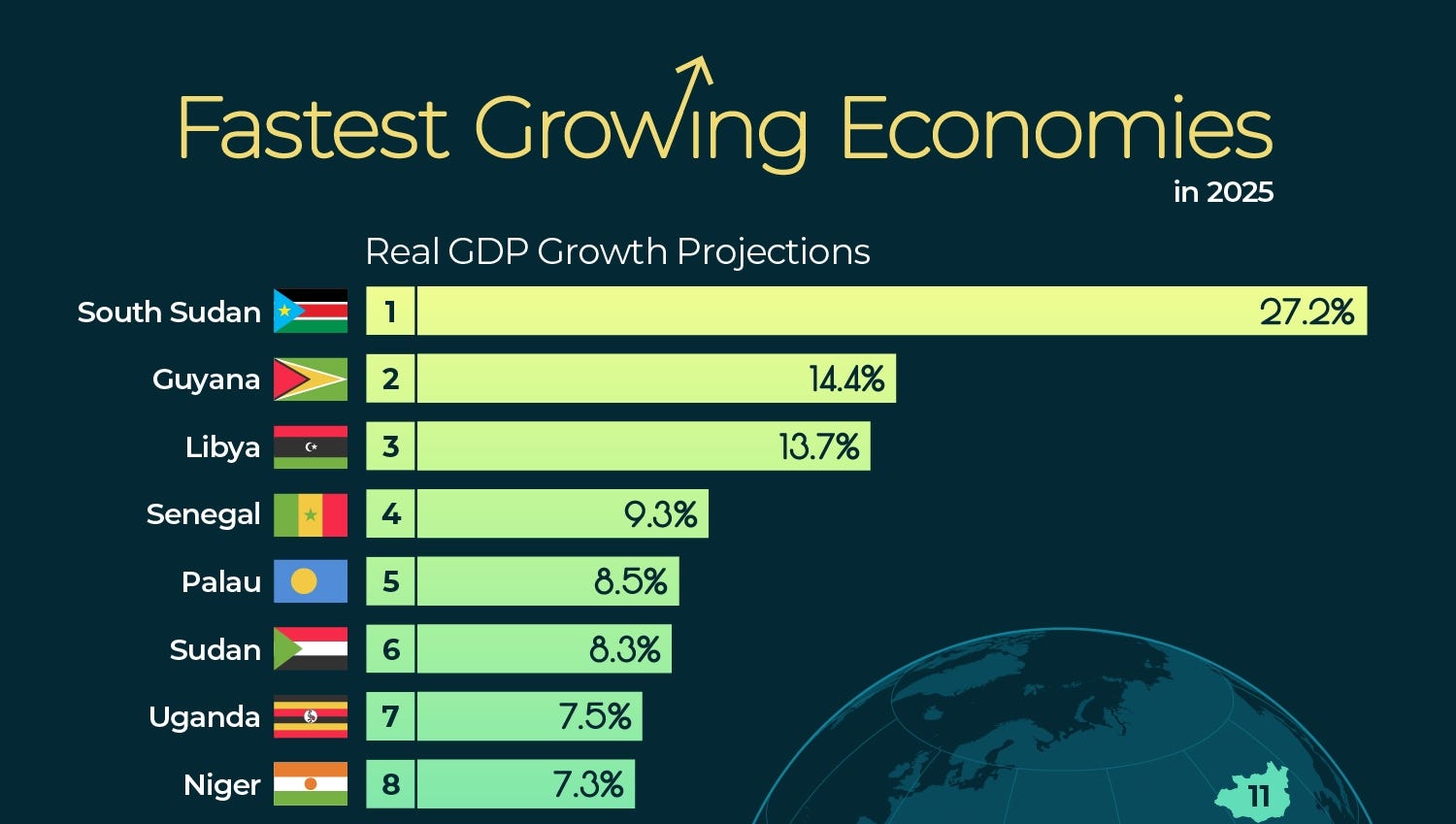
South Sudan will never be Rwanda or Botswana in a single stroke. In the spirit of having optimistic but realistic expectations, it seems that if the December 2026 elections deliver only the usual fractious elite deal-making instead of all-out war, the world’s youngest nation has a low-probability but plausible route out of its perpetual crisis.
There are a few points that form a basis for optimism:
(1) South Sudan’s economy is projected to grow by 17% in 2025 on the back of resumption of oil production and exports after a year-long shutdown. Oil accounts for more than 90% of government revenues, with exports restarting in January 2025 following repairs to the key Dar Blend pipeline disrupted by conflict in Sudan. Sporadic attacks and shipment stoppages still take place, an improvement on sustained long shut-downs. The International Monetary Fund (IMF) anticipates substantial oil revenue recovery in fiscal year 2025/2026 under a new staff-monitored program.
(2) Agriculture offers untapped scale. The country’s sorghum yields averaged just 0.37 metric tons per hectare in recent assessments, hampered by conflict and limited inputs, but remote sensing models highlight strong potential tied to land size and moisture—key variables for boosting output.
With vast arable expanses (by some estimates 70% of its land is suitable for agriculture) and bi-modal rainfall in the south, harvesting of the 2025 first-season crops concluded in August, signalling resilience despite floods and dry spells.
(3) Non-oil sectors show glimmers.
3.1. Gold mining, largely artisanal, faces entrenched corruption but generated informal trade volumes, underscoring its economic potential, should there be modernisation of the sector and political will to root out corruption.
3.2. Livestock remains vital: Cattle supply 65% of the nation’s red meat needs, contributing hundreds of millions in value annually through local markets and cross-border trade.
3.3. A young population—74% under age 30—fuels digital adaptation. Mobile money platforms like M-Gurush are accelerating financial inclusion, with surveys from mid-2024 showing widespread uptake in a liquidity-strained environment.
3.4. Connectivity is being enhanced. MTN South Sudan expanded Starlink satellite internet nationwide in October 2025, capturing 30% of the ISP market and connecting remote trading hubs from Yei to Renk.
3.5. The IMF is committed to helping stabilize the country’s debt situation, though full relief under initiatives like HIPC debt forgiveness programs remains aspirational amid arrears and fragility.
None of this is assured. A single escalation in 2026/7 could derail gains. But since independence in 2011, no prior alignment of oil recovery, agricultural pilots, youth-driven tech, and international debt monitoring has materialized.
For the first time, the building blocks for a sustained growth exist—if peace holds.