
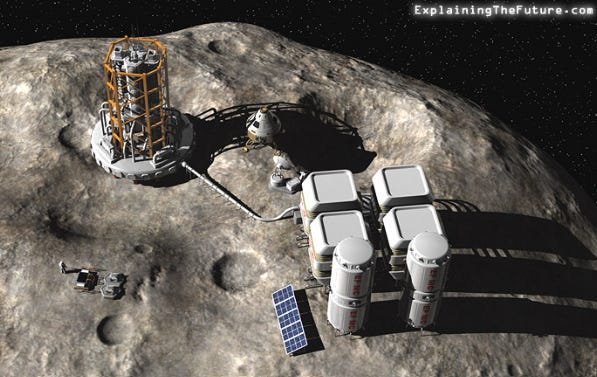
Space miners are closing in on the potential prize offered by Asteroid mining. In February 2025, California startup AstroForge launched its Odin spacecraft on a SpaceX Falcon 9, aiming for the first private flyby of a metallic near-Earth asteroid to scout platinum-group metals (PGMs). Communications glitches dogged the mission, but the company—fresh off a $55 million Series A—is pressing ahead with Vestri, slated for launch in 2026 aboard Intuitive Machines’ IM-3 lander. Rivals like TransAstra and Karman+ are testing capture tech and raising tens of millions more.
The global space-mining market, valued at roughly $1.7 billion in 2026, is projected to hit $4-10 billion by the early 2030s as launch costs plummet.
The prize appears to be worth the efforts.
Certain types of asteroids (so called M-type and LL-chondrite) are believed to hold PGM concentrations 10-1,000 times richer than Earth’s best mines—platinum, palladium, iridium that power fuel cells, catalytic converters, and renewable tech. One modest haul could theoretically be worth billions at today’s prices.
Yet the industry’s biggest headache is staring it in the face: success could destroy the very economics that make the metals precious.
Precious metals derive their value from scarcity on Earth. Asteroid mining, if it scales, flips the script. Return just a few tons of refined PGMs and terrestrial prices could crater, hammering miners, commodity traders, and the PGM market.
The hype—trillions in “asteroid wealth”—ignore this Catch-22.
Smart players are already pivoting. Many now emphasize in-space utilization—water for rocket propellant, metals for orbital construction—sidestepping Earth re-entry altogether. PGMs might still return in small, high-value doses, but bulk supply would serve the growing space economy, not compete directly with Johannesburg or Siberian mines.
The dilemma is not fatal, just instructive. Technological leaps in propulsion, robotics, and in-situ refining could make extraction cheap enough that even lower prices remain profitable. Rising terrestrial demand from EVs and hydrogen technology provides a buffer.
For now, the rush continues: more missions, more capital, more data. But the first company to strike it rich may discover that the real fortune lies in solving the market it disrupts.