
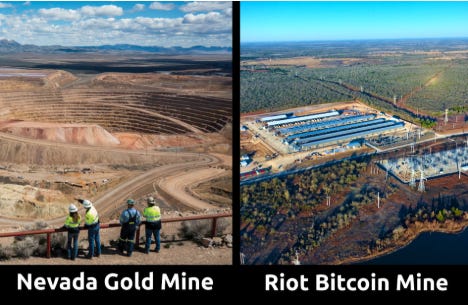
Both gold and Bitcoin mining are energy-hungry processes, but their power consumption profiles, environmental impacts, and future trajectories differ significantly, raising critical questions for investors and policymakers navigating the ESG landscape. As the world grapples with climate goals, understanding the energy footprints of these assets and their alignment with sustainable practices is just as important as the daily news about the assets’ latest all-time record breaks.
In 2020, the global gold mining sector consumed approximately 265 terawatt-hours (TWh) of energy annually, emitting roughly 145 million metric tons of CO2, according to estimates from DePaul University and other studies. This energy demand stems from fossil-fuel-powered heavy machinery, explosives, and energy-intensive refining processes.
Bitcoin mining, by contrast, is a digital endeavour but no less power-hungry. The Cambridge Bitcoin Electricity Consumption Index (CBECI) estimates Bitcoin’s annualized electricity consumption at 120-170 TWh in 2023, with a carbon footprint of 70-120 million metric tons of CO2. The proof-of-work (PoW) consensus mechanism, which requires miners to solve complex cryptographic puzzles, drives this voracious energy demand. Unlike gold, Bitcoin mining’s energy use is tied to computational power, with miners racing to deploy high-performance hardware in pursuit of rewards. A single Bitcoin transaction can consume 707 kilowatt-hours (kWh), equivalent to the energy use of an average U.S. household over several weeks.
Comparing the two, gold mining currently outpaces Bitcoin in total energy consumption, largely due to its scale—3,500 tons of gold are mined annually compared to Bitcoin’s fixed supply of 21 million coins, of which 19.7 million are already in circulation.
However, Bitcoin’s carbon intensity per unit of value is higher: one Bitcoin’s worth of gold emits about 9 tons of CO2, while a single mined Bitcoin emits 223 tons. This disparity highlights Bitcoin’s inefficiency as a “digital gold” from an environmental perspective.
The future energy trajectories of gold and Bitcoin mining are shaped by distinct dynamics. Gold mining’s energy use is relatively stable, tied to physical extraction and refining processes that benefit from incremental technological improvements, such as automation and cleaner energy grids. The World Gold Council projects an 80% reduction in gold sector emissions by 2050 to align with Paris Agreement targets, driven by shifts to renewable energy and recycling, which is “99% cleaner” than primary mining. Recycling, though more electricity-intensive, avoids the water and land impacts of traditional mining, offering a path to decarbonization as grids green.
Bitcoin’s energy consumption, however, is more volatile, hinging on price fluctuations, mining difficulty, and hardware efficiency. A 400% price surge from 2021 to 2022 triggered a 140% increase in Bitcoin’s energy use, pushing its global electricity demand to 173 TWh, equivalent to Poland’s consumption. Future growth could exacerbate this trend unless mitigated by technological or regulatory shifts. Innovations like more efficient mining chips or a potential transition to less energy-intensive consensus mechanisms (e.g., proof-of-stake, as Ethereum implemented in 2022) could curb Bitcoin’s footprint. However, proof-of-stake remains unlikely for Bitcoin due to its entrenched PoW model.
Geographic flexibility gives Bitcoin mining an edge in tapping “stranded” energy—surplus power from remote renewable sources like hydropower in Sichuan or geothermal in Iceland. Up to 39% of Bitcoin mining uses renewables, compared to gold’s heavy reliance on grid-based fossil fuels. Yet, coal still powers 36-45% of Bitcoin’s energy mix, particularly in regions like China (pre-2021 ban) and Kazakhstan, undermining its green potential.
From an ESG perspective, both industries face scrutiny but offer unique opportunities. Gold mining’s occasional environmental toll remains a concerns, alleviated by its tangible utility in electronics, jewellery, and as a store of value. Bitcoin mining is free of physical land degradation, but raises concerns over its carbon and water footprints (e.g., cooling systems for mining rigs). Its social benefits, like financial inclusion for the unbanked in developing economies, are compelling but unproven at scale.
It is only a matter of time before investors heavily factor-in these assets’ environmental scorecard in their decision making, and prices will adjust in line with those assessments. Investors and policymakers alike must demand transparency and innovation to ensure these assets don’t undermine the planet’s future.