
The Donbas region in eastern Ukraine, encompassing the Donets Basin, stands as one of Europe’s most resource-rich sedimentary basins, shaped by ancient tectonic forces and renowned for its vast coal deposits. Spanning approximately 60,000 square km across parts of Donetsk and Luhansk oblasts, this geological feature has been of interest to scientists since the 18th century for its complex structure and economic potential.
The Donets Basin was formed during the Late Devonian period around 360-380 million years ago. It originated as a rift zone on the southern edge of the East European Craton. Over time, it evolved into a post-rift sag basin through the Carboniferous and Early Permian eras, accumulating thick layers of sediments—up to 20 km in depth in some areas.
Tectonic compression in the Early Permian led to folding and faulting, creating the distinctive Donbas Foldbelt with its uplifted ridges and thrust faults. The basin’s crystalline basement dates back to the Archean and Proterozoic eras, providing a stable foundation for overlying Paleozoic rocks.
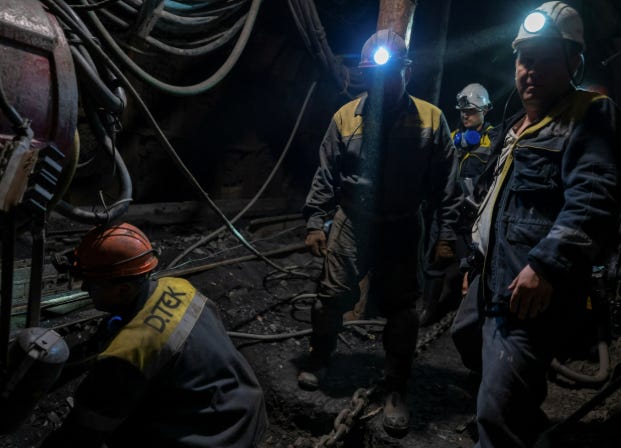
At the heart of Donbas geology lies its Carboniferous coal measures, hosting about 300 coal layers with around 130 workable seams thicker than 0.45 meters. Proven reserves are estimated at around 60 billion tonnes, including anthracite and bituminous types often high in ash and sulphur. These coals contain an average methane content of 14.7 cubic meters per tonne, making the region’s mines among the world’s gassiest.
Beyond coal, the basin boasts significant non-fuel minerals, including billions of tonnes of rock salt in deposits like those near Bakhmut (5.4 billion tonnes proven) and Sloviansk (3.5 billion tonnes), as well as mercury, natural gas, and coalbed methane.
Shale gas potential in the broader Dnieper-Donets system adds to its energy profile, while minor occurrences of lead, zinc, and copper appear in Permian strata.
As exploration techniques advance, the region’s geology continues to reveal insights into ancient environments and resource formation. The geological blessings also offer much-needed hope for future prosperity of the region as a whole.