
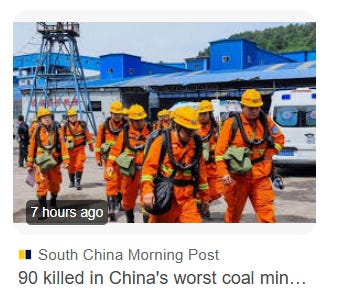
A gas explosion ripped through the Liushenyu coal mine in Shanxi province on the evening of May 22, 2026, killing at least 90 miners and leaving nine missing (at the time of writing). With roughly 247 workers underground at the time, the blast at the site operated by Shanxi Tongzhou Coal Industry Group marks China’s deadliest mining disaster in more than a decade, since the 2009 Xinxing mine explosion that claimed 108 lives.
President Xi Jinping has demanded a full investigation, with executives already detained.
The tragedy fits a grim historical pattern. In the early 2000s, China routinely lost thousands of miners annually—nearly 7,000 in 2002 alone. Official figures show steady improvement: deaths fell sharply after aggressive closures of small mines, with the fatality rate per million tons of coal produced dropping from around 5 in the early 2000s to 0.044 by 2021.
Yet China’s rate remains two to four times higher than in the United States or Australia. Even with overall declines in 2025, major accidents persist, underscoring that safety gains remain fragile.
The root cause is rarely a single technical failure. Gas explosions like the latest one typically stem from inadequate ventilation and poor gas monitoring in methane-rich seams.
But deeper drivers are systemic.
Intense pressure to maximize output—fueled by China’s heavy reliance on coal for energy security and local governments’ growth targets—encourages corner-cutting. Operators, especially in smaller or township-run mines, often violate procedures, skimp on safety investments, or falsify records. Management deficiencies and unsafe worker behaviors are frequently cited, enabled by weak local enforcement, corruption, and insufficiently trained inspectors. Complex geology amplifies risks, but human and institutional factors turn hazards into disasters.
Policy fixes and industry action could change the trajectory. Beijing should tighten central oversight with independent, unannounced inspections and tie local officials’ promotions explicitly to safety metrics rather than just production quotas.
Stricter criminal penalties for negligence, combined with subsidies for real-time monitoring systems, automation, and advanced ventilation, would raise the cost of noncompliance while lowering technical risks.
Industry bodies such as the China National Coal Association have a role beyond lobbying. They could establish rigorous peer-audit programs, fund joint R&D on safety technologies, mandate standardized training curricula, and create confidential whistleblower channels. International benchmarking and technology partnerships could accelerate adoption of best practices proven elsewhere. China has reduced mining deaths dramatically over two decades, but events like Liushenyu show the gap between regulation and reality remains wide.
Aligning economic incentives with human safety is no longer optional if Beijing wants its energy backbone to be sustainable.