
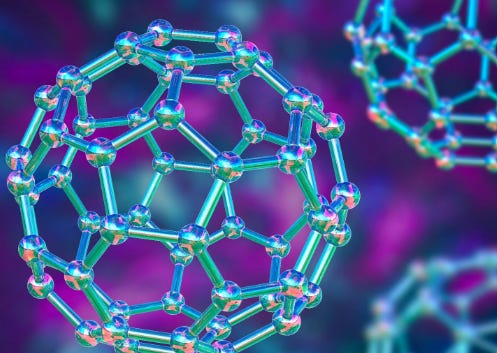
In 1959, Richard Feynman delivered a legendary talk titled “There is Plenty of Room At the Bottom”, where he sketched a future in which humans could manipulate matter atom by atom. Eric Drexler’s 1986 book “Engines of Creation” turned that idea into a blueprint for: self-replicating nanobots, desktop molecular factories, the end of scarcity.
Governments bought in.
The U.S. National Nanotechnology Initiative launched in 2000 and has poured nearly $47 billion into the field so far (2026). The radical version of the vision never arrived. The early 2000s brought hype overload—“nano” slapped on everything from socks to sunscreen. Venture capital chased the dream of programmable assemblers.
Then physics pushed back.
Drexler’s vision of tiny robot arms precisely positioning individual atoms ran into “sticky fingers” and thermal noise problems. Nobel laureate Richard Smalley’s public debate with Drexler in 2003 exposed the gap between elegant theory and messy chemistry. Self-replicating nanobots and universal fabricators quietly slid from near-term roadmaps into the long-term maybe pile.
What succeeded instead is far more practical—and already valuable.
In 2026 the broader nanotechnology market is worth roughly $120 billion and growing at 13–15% annually. Nanomaterials alone exceed $18 billion. Lipid nanoparticles carried mRNA vaccines into billions of arms. Carbon nanotubes and graphene stiffen planes and car parts. Quantum dots sharpen displays. Nano-engineered silicon anodes promise longer-range EVs, while targeted nanoparticles attack tumors with precision once reserved for sci-fi.
The trajectory has shifted from revolutionary to evolutionary. Progress now rides on AI-driven materials design, better scaling of synthesis, and integration with biotech and clean energy. True atomic-precision manufacturing remains decades away, but incremental wins—stronger, lighter, smarter materials—are compounding fast.
The revolution didn’t fail. It simply grew up: less flashy, more profitable, and steadily reshaping the physical world one nanometer at a time.