
So you think Tesla is wild? Bitcoin too crazy? Gold or oil keeps you up at night?
Well…
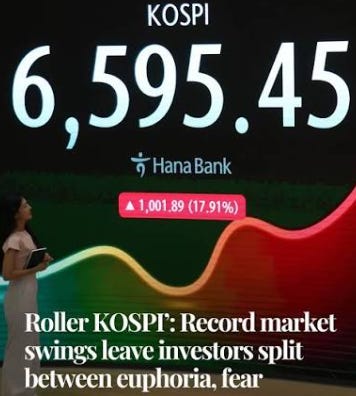
South Korea’s main stock index, the KOSPI, has recently been swinging harder than all of them. In 2026 the KOSPI has posted daily moves of 4–10% (and occasionally 17% up or 11% down) as routine. Its average daily volatility is currently the highest among major global markets. Annualized volatility has run 57–90%+, higher than Bitcoin’s at several points this year. Circuit breakers (emergency trading halts) have triggered dozens of times.
Why is a developed country’s stock market this jumpy?
Two giant chipmakers — Samsung Electronics and SK Hynix — now make up more than half the entire KOSPI. The index is basically an AI-semiconductor bet. When those two stocks move, the whole market moves with them. Now add, to the mix, South Korea’s retail investors, who pile into leveraged products (especially 2x single-stock ETFs tied to those same chipmakers). These funds automatically buy more on the way up and sell more on the way down, turning normal swings into roller-coaster rides. Margin debt and foreign money flowing in and out add extra fuel.
The result:
A market “index” that can rise or fall several percent in a single session. Your “volatile” stock or commodity suddenly looks almost calm by comparison.
This extreme volatility is overwhelmingly bad for the South Korean economy. While high volatility can offer short-term profits for agile day traders, it actively undermines macroeconomic stability. It, however, destabilises core financial systems and drives away vital long-term capital. A national stock index is not supposed to be casino-like.