
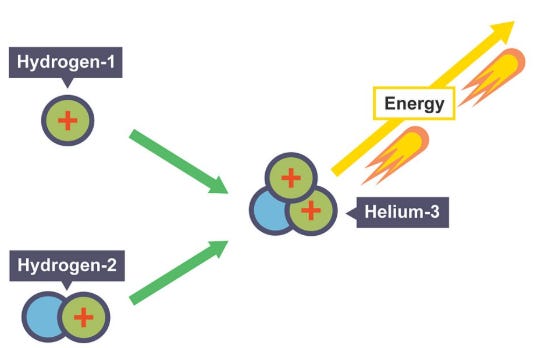
The sci-fi like promise of commercial nuclear fusion is to power all of the earth’s energy needs, including those arising AI’s compute power demands, without a single carbon atom emitted. Nuclear fusion replicates stellar reactions to generate limitless clean power. Recent technical breakthroughs are fueling excitement that perhaps as early as next year, clear signs of commercial viability could be given.
Hope-givers so far include:
In the U.S., the National Ignition Facility (NIF) achieved repeated net-positive energy ignitions, proving fusion can produce more power than it consumes.
China’s EAST reactor sustained 100 million-degree plasma for over 17 minutes.
Korea’s KSTAR hit 48 seconds at similar temperatures, and now targets 300 seconds by 2026.
These advances are relevant because containing superhot plasma and preventing instabilities have long been considered core technical hurdles that should be overcome for fusion to be taken seriously. Even Google is chipping in on helping solve these challenges, using DeepMind to conduct plasma simulations and figure out how to stabilize reactions.
Deals are pouring in to help bring in much needed finance into the push. Trump Media’s $6 billion merger with TAE Technologies aims to break ground on the world’s first utility-scale fusion plant in 2026, starting at 50 megawatts.
Google invested $863 million in Commonwealth Fusion Systems (CFS) and inked a 200-megawatt power purchase.
In the search for power sources that will enable full AI capabilities, all energy sources - proven or otherwise - are on the table. AI Data centres could guzzle as much electricity as entire countries, and fusion promises abundant, zero-emission supply to feed the humanity-saving beasts.
Yet, pessimism lingers. Fusion’s history is littered with “30 years away” jokes—delays from engineering woes (apart the basic science challenges) like material degradation under extreme conditions still persist. Sceptics warn of hype-over-substance if 2026 pilots flop.
Will 2026 finally be a sunrise year on the path to a limitless-energy future, or be just another year when we conclude that we are still 30 years away? Atleast we wont blame lack of investment for either outcome.